Workforce infrastructure for Africa.
RTG designs, builds and runs the systems that make a country's workforce visible: who is employed, which skills they hold, where demand is growing, and what the law requires.
LiberiaWorks
The national employment and workforce platform, built and run with the Ministry of Labour across all 15 counties.
Live
Energy sector skills
Mapping the roles and skills the energy sector needs, and the gaps between them and the workforce in place.
Early-career pipeline
A private route into agriculture and green energy, built with the employers hiring at entry level.
The rules exist. The records do not.
Employment law in many African countries already requires registration, workforce reporting and foreign worker compliance. What is missing is the system that carries it.
It runs on paper
Registration and returns move on forms and scattered files. Employers face slow, unpredictable processes, and workers hold no record that follows them.
Nobody sees the whole
No institution holds a current picture of who is employed, which skills they hold or which skills are short, because the information was never gathered in one place.
Decisions rest on estimates
Workforce policy, local-content commitments and skills spending are set from surveys and projections rather than from the employment record itself.
Live in Liberia
LiberiaWorks
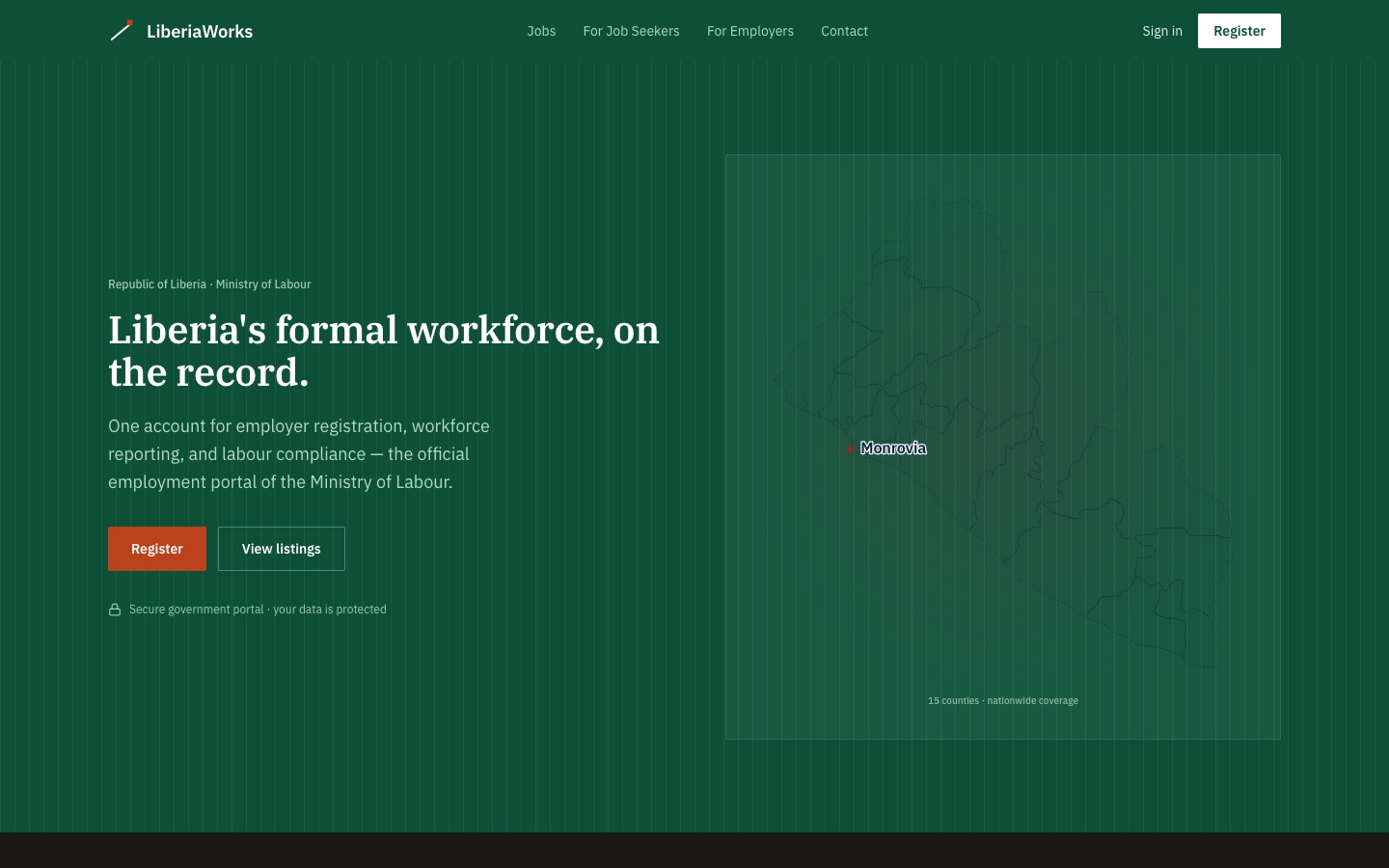
Liberia's national employment and workforce platform, built and operated by RTG with the Ministry of Labour. Employer registration, workforce returns, foreign worker compliance, vacancies and placement programmes run through one platform, across all 15 counties.
- Legal basis
- Administrative Regulation RL/MOL/CWK/M/1011/'25
- Coverage
- All 15 counties
- Status
- Piloted with 400 employers over the year to September 2026. Now open to employers nationwide.
- RTG's role
- Designed, built and operates the platform with the Ministry of Labour
- Register once
- File workforce returns
- Post vacancies
- Hold a verified profile
- Apply for open roles
- Join placement programmes
- Administers the system
- Oversees compliance
- Reads labour-market data
One model, pointed at a country or a sector.
Liberia is the national deployment. Uganda and Kenya are private projects, each pointing the same role and skills model at a single sector: what the work requires, and who is coming into it.
- Workforce demandWhich employers are hiring, for which roles, and what is coming as projects and seasons change.
- Skills gapsWhere the skills a role requires and the skills the workforce holds pull apart.
- Labour-market dataA continuous record that ministries, industry bodies and training providers can plan from.
Energy sector skills design and gap analysis
Uganda is adding capacity across generation, transmission and oil and gas. RTG maps the roles the sector runs on and the skills each one requires, measures the workforce in place against that map, and reports where the gaps fall as projects come online.
Read more KenyaAn early-career pipeline for agriculture and green energy
Both sectors hire at the entry level, and both are changing faster than the training aimed at them. RTG runs a private pipeline with the employers doing that hiring: the roles they are opening, the skills those roles need, and the people coming into them.
Read moreDesign, build, run, develop.
RTG does all four. A system nobody operates, and a workforce that cannot use it, are the two ways this work usually fails.
Design
Diagnose the labour market. Design the rules, processes and data model with the institution that holds the mandate.
Build
Build the platform and its data model once, so it can be configured for new countries and sectors.
Run
Operate the system with the ministry or industry body, including employer support and reporting for government.
Develop
Use what the system shows to raise productivity, through placement, training and skills programmes.
Work with the employers the systems record.
The same work that produced LiberiaWorks is available to employers directly.
Workforce development and training
Localization and junior associate programmes, apprenticeships, supervision and management training, and AI and digital skills, delivered with the employers who use the systems.
Read moreEmployer compliance support
Help for employers registering on LiberiaWorks and keeping their workforce records current, complete and ready for submission.
Read moreAn African workforce systems company.
RTG designs workforce systems with the institutions that hold the mandate, builds the platforms, and runs them. Each system gives employers one predictable process, workers a verified employment record, and government continuous labour-market data aligned to ILO standards.
Founded in 2022 and based in Nairobi.